⚠️ Courtesy Notice:
Stories:
A paragraph in this story contains a depiction of sexual assault. Those who wish to avoid such content may prefer to skip the paragraph after the caution symbol as seen above.
END NOTES:
BREATHE DESCENDANTS
I attended my eighty-eighth Holotropic Breathwork (HB) workshop in early December 2019 and experienced something that completely changed how I understand humanity’s future. As I made the familiar drive through the Vermont hills toward Lenny and Elizabeth Gibson’s home and workshop venue, I had no sense of anxious anticipation about the upcoming session, no pressure to get anything out of my body as I used to have so often before these events in my early years of attending breathwork workshops. I had no inkling of what this workshop session might bring. I did not even feel any strong spiritual inclinations, which was unusual. But then, as I packed my gear, I thought perhaps I should bring one small vial of sacred water to give to Elizabeth, as she knew the story behind the Erie Blizzard water. [1] When I reached for it, that inner voice—the same one that in the past had encouraged me to hand the vials out more generously —spoke again: Take all of the vials.
Without hesitation, I filled a small plastic bag with them. Upon arriving at the Gibsons’, I placed all of the vials on an altar where participants were invited to leave sacred objects. When it was my turn on the mat, [2] my breathing session began, absent of trepidation and expectations. I was no longer processing and releasing trauma kinetics. [3] I was like a beginner again, unsure what breathwork would be like at this stage of my spiritual journey.
When the music began, I went from stillness to shaking my hands with an energy both familiar and intense. The song included sounds of water intertwined with rhythmic drumming, which evoked childhood memories of paddling our aluminum boat around our pond, staring into the depths in search of the largest fish, specifically a bass. My pleasant memory swirled into a vision, and the common bass morphed into an extraordinarily large Amazonian fish. This was no regular river monster. It was Arapaima, one of my spirit guides, who beckoned me to follow. Suddenly I was swimming in clear blue water behind the great fish-spirit.
I was not very deep into the non-ordinary state of consciousness (NOSC) yet, so ordinary thoughts intrude. Worries about downsizing my job disrupted my calm. The conflict between reducing my hours—and income—and my desire for more time to write, contemplate, exercise, and rest tugged at me. In my ordinary mindset, I would have ruminated endlessly. But now I had non-ordinary options. One was to use my spiritually charged heart, the one Emmie, my now deceased younger sister, had given me during a previous session. I recognized that my worries belonged to a paradigm dominated by fear, one I no longer wished to inhabit. Simply acknowledging this caused the Universe to respond through my new heart, shifting the vision. I was suddenly aloft, no longer underwater.
Instantly a sword appeared—my ancestral warrior-shaman’s sacred sword. Without hesitation I grabbed it, invoked its power, and sent it tumbling end over end. It traveled several yards, angled downward and struck like a viper. When it plunged into a person lying on the floor, I realized the person was me. The “I” invoking spiritual strength was not the same as the “I” who worried neurotically; hence the distance between them. The sword landed squarely in my abdomen, goring the belly of my fear. I felt no pain—only relief as energy released from my abdomen. I smiled briefly, recalling Stan advice: “Never pass up an opportunity for death and dismemberment.” Stanislav Grof, MD, creator of HB, would undoubtedly say this qualified.
A stillness settled over me. Within it, I became acutely aware of a significant imbalance of mismatched energies permeating my body and soul-self. I had experienced mismatched energies before and recalled a mandala from a previous session showing my heart blazing with fiery red and yellow flames indicating too much energy while my depleted body melted from exhaustion depicted by variously colored drops of liquid running down the page. The mental image faded, and my body began to shudder—not externally, but with internal explosions of energy. I longed to thrash on the mat, but I knew my sixty-year-old body, with its vulnerable neck and back, could not handle it. I resisted. After each explosive wave, exhaustion followed; then another wave hit. The alternating surges of energy and depletion were exponentially more uncomfortable than either alone.
Out of nowhere, came the notion that I needed the element of fire. Odd, since fire had only occurred infrequently in previous NOSC sessions and was not part of my spiritual repertoire. Rather than invoking a specific fire entity, I simply held the idea of fire in my mind and made a broad request for help.
To my surprise, Grandmother of the Good Dark responded. She usually appeared in a womb-like yurt offering a ladle of magical elixir, but this time she came with mystical fire. She sat before a large bonfire, feeding it with energy pouring from her palms. I knew instinctively that I must enter the blaze to burn off the opposing energies. I did not step forward; I simply thought the desire, and instantly I was in the flames. I felt no pain, even as my volatile energies caused the fire to roar and spiral. Grandmother continued feeding it, and together our energies fueled an enormous inferno.
⚠️ Suddenly I began to choke. An obstruction seemed lodged in my throat; I could barely breathe. A child-self surfaced from deep within me and filled my body. My adult mind understood instantly: I was reliving a segment of childhood sexual abuse. My body writhed, howling noises erupted, and fear spilled from me into the fire, which now whirled around me, burning away residual abuse energy. The trauma echo [4] of the abuse was powerful but brief—minutes instead of the hours such processes once required. Again HB was aiding me in extricating old trauma kinetics from my body.
Even with all the energy already cast into the inferno, it seemed to need something more. It needed an additional catalyst to fuel this visionary journey, and I knew just what that meant. I had to sacrifice something, and just coming to this conclusion caused the appearance of a dazzling sacred heart–the one gifted to me by my deceased sister during a previous NOSC journey. As much as I wanted to hold it, I had learned the importance of surrendering even precious things. I released it and watched it stoke the flames, causing another tremendous fiery acceleration.
An intention seeped into my awareness; a yearning to “go beyond.” I did not know what that meant or how to begin such a thing. Reasoning and problem-solving were not available. There was a growing sense of urgency, so I let go, trusting my inner healer.
All the energy that had been infused was expanding into a tornado of flames with tremendous spiritual power. As I witnessed this nuclear expansion of energies, I began to grasp what “going beyond” meant: the Grand Beyond—beyond what I know, what is known, and what will be known; beyond Light, beyond Dark, beyond our cosmos and all universes. As understanding dawned, I was transported there.
Physically, my body was completely still and comfortable on the mat. My breathing was quiet. No more trauma echoes remained. In the vision, I was in an immense, colorless expanse with no discernible boundaries. It seemed infinite. Despite the drabness, a faint shimmering hinted at “what might be.”
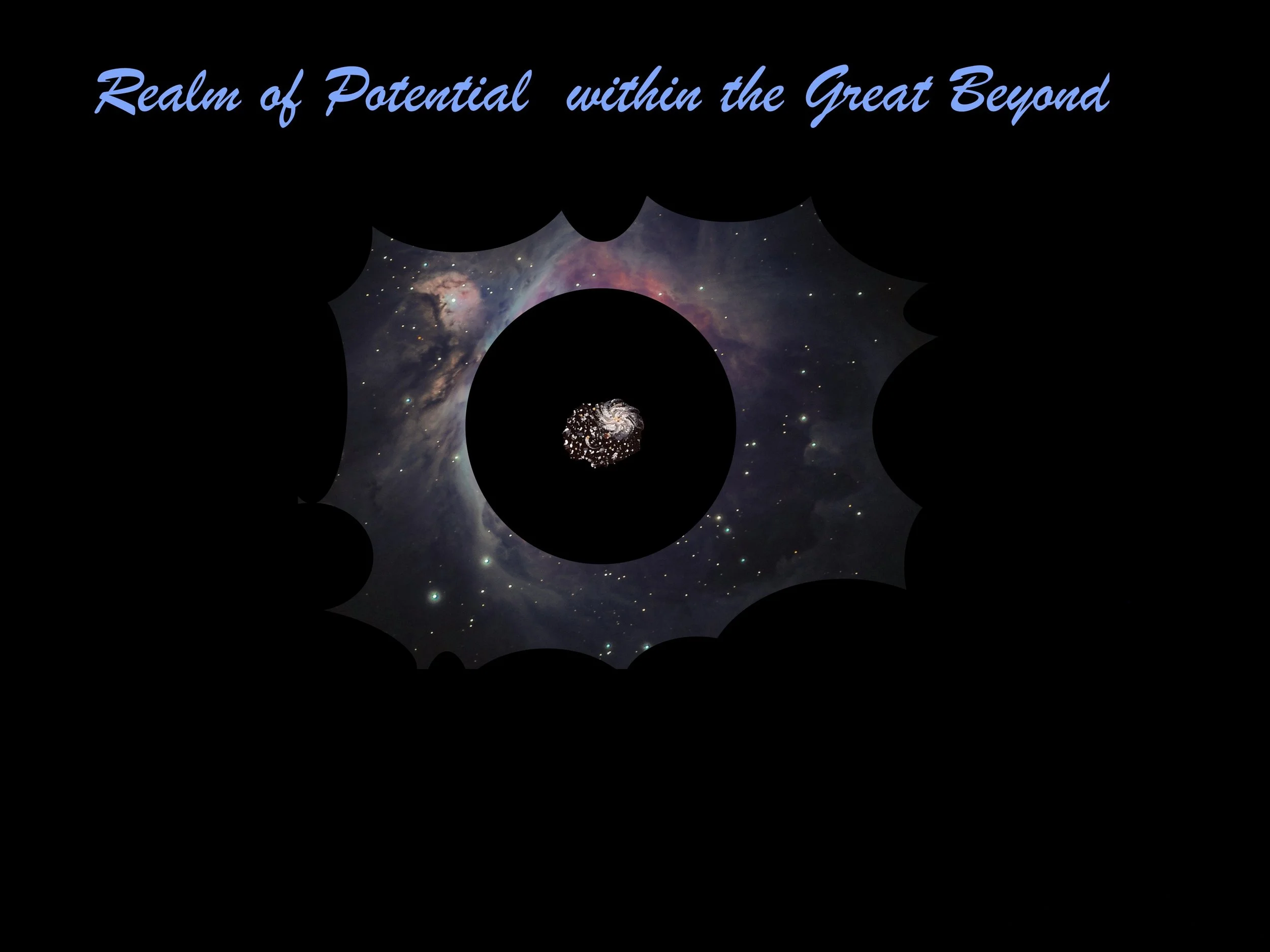
Gradually I understood that I was in a region of the Grand Beyond, best thought of as the Realm of Potential, where there was no matter, no energy, and no time—only the potential for everything, for all things, while simultaneously having nothing, or no thing. At first, I felt some excitement about what might become from this vast potential, but as some time passed,” nothing emerged. Soon my humanness became restless with no things and had an urge to create––to grab, to mold, to awaken some of the potential. Yet to make something is to determine it, to give it a beginning and an ending, which means there’s a component of time, and as time could not exist in the Realm of Potential, I could not create.
A realization emerged: this place of all potential was not a good place for me to remain. A timeless nothingness might be more hell than heaven. Before discomfort grew, an all-encompassing light appeared—the magnificence of a millennium of sunrises. A God force. A divine dawn that was the beginning, the birth energy of the cosmos and its universes.
Unexpectedly, a blazing bolt of this Dawn Light shot into the drab Realm of Potential and was absorbed into myriad potentials, catalyzing shimmerings that coalesced into clouds. The “clouds of beginnings” blossomed into colors—blues, greens, magentas, oranges—and condensed into rivulets of giant “drops of formation.” A birth. A becoming. The opposite of “no thing.” It became Is-ness.
The shimmering Is-ness coiled inward like a seashell, spiraling tighter until it condensed into a single dot—a portal. Without hesitation, my consciousness dove in.
On the other side, the Is-ness reorganized into a complex design of colors and shapes. The “Geometry of Becoming” labeled itself in my mind. A circle with crisscrossing lines forming triangles, trapezoids, polygrams, all in brilliant colors. A divine mandala! I wondered, Is this what people mean by “sacred geometry?”
The Geometry of Becoming continued to morph into smaller fractals, then into something entirely different. As the motion of the imagery slowed, the large almost panoramic vision-scape of geometric wonder condensed and the image sharpened: the Geometry now miraculously existing within the iris of an eye. What began in the Realm of Potential and birthed into Is-ness was evolving from inorganic fractals into more complex organic matter. At any point this amazing evolution could have ending, yet it continued.
From a single iris, the Geometry of Becoming morphed further into a group of non-distinct beings. I could not discern features or numbers, only that they were a group. But I knew who they were: Beings of Awareness—evolved humans in an awakened, expanded state of consciousness. They conveyed that they are Divine Descendants, our collective descendants, emerging through a spiritual mechanism from present-day humans.
When they saw that I understood, they took hold of the reins of my journey. As if rewinding a film, I was back at the moment when divine Dawn converged on the Realm of Potential. This time they zoomed in on a tiny dark patch at the center of the light—something I had not noticed. It was instrumental in what followed.
Colors and shapes came into focus first, and then recognition flooded me. They were showing me myself. I saw my breathwork mat, sheet, clothing, blanket. The sight lasted only moments, but long enough for understanding: my engagement in breathwork had produced a seed within the Divine Dawn, contributing to the genesis energy. I saw myself be an active participant in cosmic creation.
Awakening to my own divinity floored me. Tears spilled as awe washed through me—like praying and suddenly finding God standing before you, smiling. I was stunned to see myself as having agency in such an extraordinary moment. I wished I could immerse myself fully in creation, but it was not possible—not yet—while I remain carnate, anchored in material life.
Even so, the Beings of Awareness revealed a fundamental truth of what it is to be a conscious human. This truth is obscured by our habit of projecting sacredness, powerfulness, and gloriousness onto deities. But now, having “lived” the sacred truth that divine attributes like creating a cosmos, lie within each of us, I gained a much deeper appreciation for the magnitude of that reality. For just a moment, because I was open, with my ego absent during NOSC, I shuddered with the full impact of knowing my true divine nature. Even more, I understood the colossal transformation that would occur when all humans recognize our individual and collective divinity.
Flooded with awe, I thought this must be the pinnacle of the vision. But the Divine Descendants were not done. They conveyed yet another truth: “You do not breed descendants into being. You breathe them into existence.”
It felt ancient and prophetic. I could not fathom its full implications, but I understood that humans have long lived under a misconception born of three-dimensional logic—breeding rather than breathing our descendants into being. We have created myths around procreation, leading to overuse of resources, and imbalances. “Breathe,” in this context, meant the sacred work of exploring and evolving consciousness through breathwork, entheogens, ceremony, and mystical ritual.
I wanted to ponder the implications of all this further, but the Divine Descendants had more to teach me. They wanted me to know them and their purpose.
They are ethereal and able to cross time. We, living humans, have interpreted them as angels, spirit guides, even ghosts. They guide, teach, and sometimes disrupt to push us toward spiritual quests aligned with the meaning of “breathe.” They give signs, intuitive gifts, insights, creative downloads, and access to the collective unconscious. Their agenda is humanity’s spiritual evolution; the higher we rise, the better their circumstance. They cannot manipulate matter in our reality, which is why it is our task “to materialize the spiritual or spiritualize the material,” as Jacqueline Small writes in Becoming a Practical Mystic.
Through years of NOSC, I have come to understand the importance of bringing spiritual concepts into the three-dimensional plane as matter, and also in action. Giving away sacred coins, gifting labradorite stones, hanging paintings of spirit guides, and sharing vials of sacred water are some ways of doing that—doing what they need us to do. The Divine Descendants let me know that when any of us follows their guidance, they are elated.
Another visual image flashed in my mind’s eye—the vials of sacred Erie Blizzard water. Then I witnessed the Descendants reach back in time, into the Realm of Potential as it was coalescing into Is-ness, to gather some of the swirling drops of creation and insert them into the vials on the altar. This blending of NOSC vision and three-dimensional reality was new to me, but the implication was clear: the sacred water had been infused with additional spiritual energy, and I was to share it with the workshop participants.
Their final message appeared as written words and as a voice: When you dream Light, dream Shadow, breathe Vision, then we call you “the Enlightened.” I understood that our Divine Descendants consider us as their ancient creator-ancestors. We are the ones who breathed them into existence.
I drifted back to ordinary awareness, resting in stillness as sweet music filled the room. The entire experience replayed in my mind. Many images had come through distinctly, and I realized they would become my mandala. But how could I portray such complexity on a single sheet of poster paper? As in past sessions, puzzling over the problem what to draw on my mandala elicited an Inner Healer response. I saw the first part of the session on one sheet, focused on the portal point. I assumed the rest would need to be written on the back. Instead, another image flashed: separate sheets forming a set of flashcards. When I rose from the mat, I began creating them.
The workshop wrapped up with lunch then a gathering for our final sharing group. [5} I listened to all the others’ experiences, and I waited until last to share mine–including how the Divine Descendants had infused the vials with additional spiritual power. I invited each participant to take one. I had brought exactly the number needed, including one for Elizabeth and Lenny. In one of those synchronistic moments, I realized that what occurred during my session had answered one of the participant’s existential questions. She too had a substantial trauma history and was healing through her breathwork experiences.
“Why am I going through all this,” she’d asked, “what is the purpose of it?” Meaning, why was she engaging in this difficult process of opening the Pandora’s Box of her traumatic past using HB. After I finished my sharing she said, “Now I understand why I am doing this; why we are doing this.”
Deep psychospiritual work involves not only “moving toward wholeness,” as Grof says, but also evolving spiritually such that we integrate the sacred into our lives for the enhancement of humankind and elevation of our collective consciousness.
Driving home, my mind drifted through years of healing—from early childhood trauma to spiritually rich experiences. I marveled at my growth and my ability to move into expanded consciousness. Then a notion about Donna, my deceased neighbor, with whom I had a posthumous visitation during one of my first therapy sessions, hit me: Was the ghost of Donna actually my Spiritual Descendant? Is that how it worked? As I pondered this possibility, a deep sense of affirmation flowed through me. The rightness of it clicked into place.
HB facilitators teach that a breather’s process does not end at the close of a workshop. Integration can continue for days, weeks, even months. . A month later, during a massage by Aniela, a gifted therapist, I experienced a continuation of the vision. The concept of breathing our descendants into existence floated into my mind, followed by a question: Who breathed us and our complex, power-imbalanced, technological society into existence?
An answer came immediately, in the form of a vision.
I saw early humans, nomadic and struggling. Some lived in harmony; others did not. Some suffered losses from storms, disease, predation. They observed the mighty oak towering over smaller plants, shading and stunting them. They observed rivers overflowing after storms, breaking off chunks of land. Size and strength meant domination. They envied it. In their prayers and ceremonies, they focused on domination energy. They breathed it into humans, gifting us ambition, competitiveness, and the drive to explore and conquer—qualities that led to scientific discovery but also cursed us with a thirst for power. This imbalance has resulted in genocides, global warming, pollution, and mega-corporations dominating the world economy with little conscience.
It is now our choice to breathe balance back into the world—not by rejecting technological advances, but by integrating them into a new paradigm of harmony. Efforts to end injustice, eliminate poverty, clean up pollution, and cultivate a conscientious culture are essential, but more is needed to correct our extreme imbalance.
Each of us stands between ancestors and descendants, forming the loop of infinity. Every sentient being is a node at the core of that infinity—both the result of creation and an agent of creation. We need people engaging in NOSC who will breathe, in the sense described by the Divine Descendants, to bring forth the harmonious world available in the Realm of Potential.
We often give up our power, believing our individual efforts cannot matter against such enormous challenges. But that belief is profoundly untrue. The truth is that we may not see the changes, but they are occurring. This is why faith in our inner healers and understanding the quantum nature of existence are paramount to our spiritual evolution.
[1] Erie Blizzard sacred water is described in Chapter 38 of Soul Can You. The water was collected during a record breaking blizzard in Erie, PA.
[2] Mat – if you have not read my book, you might be unfamiliar with Holotropic Breathwork which is a self-improvement endeavor done in a group setting where pairs of people take turns on a mat breathing deeply and listening to special music that helps transport a person into a nonordinary state of consciousness.
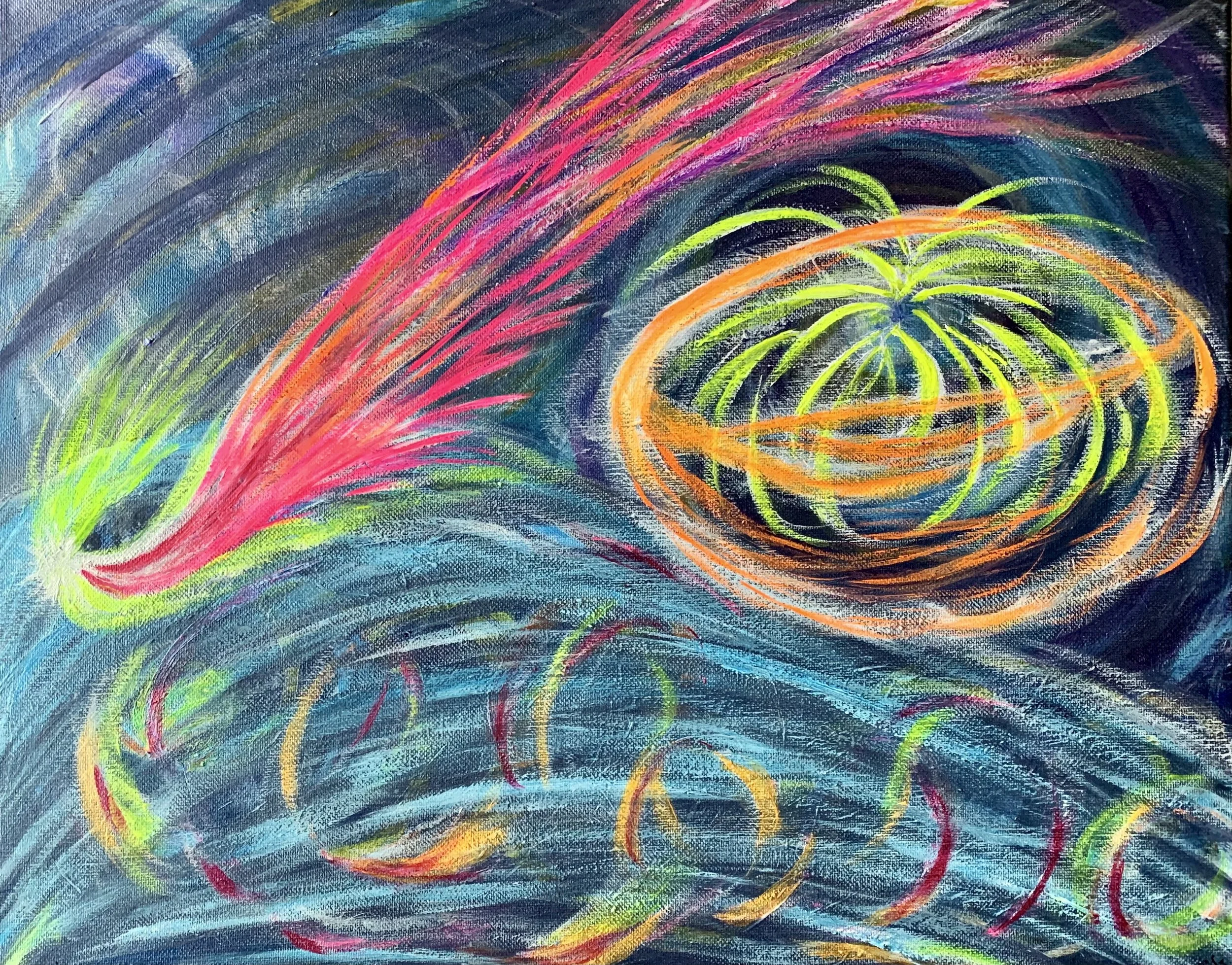
Process painting using metallic acrylic and florescent paint.
There are energies we see but also the unseen which are sometimes felt or sensed. Wormholes, vortices and slip streams that serve as portals to other space/time dimensions or universes. The imagination of such is infinite.
[3]Trauma kinetics –a state of being produced by significant or repeated trauma, characterized by a pervasive energy that affects the body, mind, and soul, influencing nearly every facet of life—whether consciously or unconsciously.
[4] Trauma echoes – reverberations of trauma kinetics that are less potent and less distinct than trauma flashbacks.
[5] Sharing group – an integrative part of a HB workshop when participants get together in the circle after the breathwork to share their NOSC experience.
COSMIC ENERGIES
(This autobiographical story was edited in part by Copilot ai. None of the content nor creative ideas were obtained via ai.)
A VETERAN’S JOURNEY FROM NUMBNESS TO SACRED AWAKENING
Opening Reflection
My breathwork experiences gave me an invaluable gift: the grace to speak with humility and compassion about death, trauma, suffering, and the ineffable mysteries of the Sacred. But even before I stepped foot into the world of Holotropic Breathwork®, I’d known there was more to life than the narrow reality we are expected to accept. Hints at a deeper and richer level of consciousness popped up occasionally until the doors were flung wide open during my healing journey. So when many have quietly whispered a deep ache: “There must be more to life than this,” I knew in my bones that there was.
What’s often missed is that finding the “more” begins not with seeking—but with stopping. We must halt the chatter, the scrolling, the numbing cycles of doing and judging and yearning. Only then, in stillness, do we hear something ancient begin to stir.
Introducing Linden
Linden was one such soul on the edge of awakening. A Vietnam combat veteran and former law enforcement officer, he lived wrapped in armor forged by war and forged earlier still, by the violence of his childhood. He had raised a family, loved his wife and sons, but lived with constricted emotions that made connection feel less complete. He knew something was missing—and had known it for years. No medication or conventional therapy could touch the dull ache at the core of his being.
He wasn’t broken. He was simply frozen—his inner life locked away for safekeeping in the long shadows of trauma and the subsequent rage bridled by emotional armor. To keep the armor in place it required him to avoid stillness, so he was busy and always on the move.
The Turn Inward
When Linden began working with me, he was searching—initially for a medication that might help. But the truth became clear quickly: there was no chemical remedy for the soul’s longing. So we pivoted. We moved toward trauma-informed psychotherapy, and further still—into the quiet territory of inner exploration.
Informed by my own healing through non-ordinary states of consciousness, I understood something many clinicians don’t voice: that deep, spiritual reconnection is often a necessary ingredient in true recovery. Not religion—but direct relationship to something vast, and Sacred. For Linden , a New Englander and agnostic shaped by pain and betrayal, the idea of a loving God felt absurd. He needed to discover his own path.
So we began where all journeys begin—with a question: When do you feel a bit freer, able to let your guard down a notch?Is there a place you feel calmer, less frazzled? For Linden , the answer was definitive. Alone, in the woods, beside a brook, when he could stop moving and simply sat, something inside him shifted. Anxiety ebbed. Self-loathing stilled. Depression waned.
This was his version of “centering.” Later he identified that centering himself in nature was also his connecting to a Higher Power, an insight that had taken a while to unfold.
Develop a Practice
Over time, his centering visits became more frequent. But he expressed frustration that he “couldn’t meditate like other people.” I suggested he try something different and offered that he could try envisioning a child, specifically his younger, wounded self sitting beside him in the woods—sharing in the stillness, safety and acceptance without judgment. Tears came at just the suggestion of doing this and more came when he eagerly embarked on his “homework assignment.” And eventually he experienced joy—when he felt that boy join him in peace. It was in this way that Linden developed a rhythm of numinous connection.
Rinse and Repeat
Over the next year or two, however, Linden would periodically arrive for a session feeling frazzled and anxious. I would gently ask, How often are you visiting the woods?
On one such occasion Linden began chastising himself, “I know I should be going.” He sighed and asked, “Why haven’t I been going to the woods? I know I’d feel better. What’s wrong with me?”
It was the perfect moment to introduce him to two powerful words—ones my own therapist had offered me during the thick of my trauma work: of course.
“It’s like being your own benevolent guide,” I told him. “You smile inwardly and say, ‘Of course you fell out of practice. Of course you slipped back into misery. Isn’t this the inner emotional landscape you’ve known for most of your life?”
I explained that though it is painful—it’s also familiar. Trauma etches patterns on our brains. It is how conditioning works and in the case of trauma is even a more potent process.
I went on: “The moment you notice yourself submerged again in depression, anxiety, or a negative sense of yourself—that’s your opportunity. Rather than reject or berate that version of you, take his hand, just the way you did before with your child self and gently escort your anxious, unhappy, misery-laden self back into the woods. That’s where self-acceptance begins. That’s how the cycle starts to shift and undo those trauma engrained patterns.”
Linden understood. In the past, he had fought himself every step of the way—resisting the magnetism of old patterns, then punishing himself when he inevitably gave in to them. He tried to detach from the wounded part of himself and that brought some fleeting relief—but it also blocked true healing, because it was a form of self-rejection. What he needed, instead, was self-compassion.
He left our session that day committed to return to his sacred, serene spot in the woods—this time, not as an escape, but as a reunion. He would bring his compassionate awareness alongside his suffering self and sit with both.
The Sacred Encounter
Then, one morning, something shattered the ordinary and expanded Linden ’s concept of reality.
He stepped outside, coffee in hand, into his familiar yard. There stood a tree—a tree he had planted decades earlier, when he and his wife had moved onto their land. It was just an ordinary tree. But at the same time special because he considered it, his tree.
Before his eyes, his tree morphed. The bark and leaves began to glow. The tree pulsed with luminous energy. It felt alive in a new way—translucent, shimmering, flowing with something unseen but undeniably real. He described it as witnessing the life-force energy within the form. The veil between worlds had thinned, and in that space, he understood something wordless: everything is connected. Everything is alive with sacred energy.
He scanned the rest of the yard—unchanged. No hallucination. No stroke. Just one tree transformed, glowing with the Sacred. And then, as quickly as it had arrived, the vision vanished.
But something had changed. Linden had witnessed it. He was infused with awe as he realized he had just had an incredible spiritual awakening. It had really happened! It really happened to me!
Integration and Compassion
It took time to understand what had happened. Session by session, he integrated the experience—how it shifted his sense of self, arriving at acceptance of the truth that he was indeed connected to something Sacred. One quiet revelation was immediately clear: his emotional numbness was gone. He felt even closer to his family. More present. More real.
But one day, just as he was leaving my office, he turned and asked—gently, almost shyly—why he still didn’t feel he had compassion for others, why he had it only for his family.
I said, “Linden , remember the first thing you did today? You asked how I was doing.”
He nodded.
“And when I gave a quick answer, you said, ‘No, really—how are you?’ You wanted to hear something genuine, not just a platitude, right?”
He blinked. “Yeah. I did.”
“That’s compassion,” I said. “You just didn’t know you had it.”
He opened his mouth to protest—and stopped. For once, he let the truth sink in. He had felt true compassion and now was aware of it.
A Larger Awakening
There’s no way to adequately thank someone for sharing their awakening. All I could offer was quiet gratitude. What Linden gifted me was confirmation of what I’d long believed: that healing is possible, even when pain runs deep.
Through my own breathwork and spiritual growth, I learned that trauma doesn’t need to own us. Transcendence is real. And when someone chooses to move out of survival into truth, they don’t just heal themselves—they bring Light back into the world.
Linden took the hand of his most broken self, walked him into the woods, and sat beside him in grace. In doing so, he discovered that the Light had always been there—waiting. His story reminded me that the Divine is not somewhere else. It lives in us. Even when we forget. Even when pain blinds us to it.
We are a species on the edge of awakening. But to rise, we must first turn toward our wounded selves—individually and collectively—and meet them with compassion.
We often ask, Why are we hurting our planet? Why are we crafting policies that oppress, divide, and deplete? The answer may be this: we are still in the phase of seeing our shared trauma and would benefit from invoking the powerful words, of course. Only when we act compassionately, holding our collective hand and leading ourselves, lovingly, into stillness and suspend the chronic trauma behaviors and reactions—only then will we reclaim our true essence and let go of destructive patterns, and allow humanity to expand consciousness thus realizing resonance with the Sacred.
Light is leaking in through our cracks. Linden saw it. So can we.
[The name Linden is pseudonym. He has given permission to use his story.]
Article:
How Do You Know if You Are Ready for Psychedelics?
By Lisa Gilbert, MD
Published on LinkedIn Jun 2026
How do you know if you are ready for a quantum leap in your healing journey? You may desperately want change, feel like you can’t stand your life as it is, or be fed up with the same painful patterns and stumbling relationships. Those are powerful motivators—but by themselves, they don’t equal true readiness.
Processes that open nonordinary states of consciousness (NOSC)—such as psychedelics or Holotropic Breathwork—can help you release old patterns, step into new phases of growth, and expand your creativity. But they are not casual undertakings. Are you ready for such an enormous step? What does “ready” actually look like?
1. Recognizing the function of your old patterns
Old patterns that have become dysfunctional still serve a purpose. They are familiar, predictable, and feel solid—even when they hurt. They act as an anchor, a reference point in an otherwise uncertain inner world.
That may sound unnecessary until you are suddenly free-floating in unfamiliar emotional waters with nothing to stand on and no end in sight. Imagine being in the middle of the ocean in a barely floating rubber raft: no paddles, no anchor, no land or boats in view. The ocean tosses you at its whim. In that moment, you might wish you had not let go of that old, unchanging buoy you had clung to for decades. It wasn’t taking you anywhere new, but it was stable and predictable.
Readiness means being willing to loosen your grip on that buoy and tolerate the feeling of “free-floating” in an emotional ocean—at least for a while.
2. Not going it alone
Do not attempt a major healing journey in isolation. Assemble your “travel team”—the people and beings you can count on when you feel most vulnerable and uncertain.
Human support: friends, relatives, therapists, peer-support groups, ministers, neighbors, and others who genuinely care about your well-being.
Animal support: many people know their four-legged companions are far more than “pets.” A purring cat against your body or a joyful dog nudging you to play can be profoundly regulating and healing.
Spiritual support: for some, this includes guardian angels, spirit guides, masters, ancestors, or other spiritual helpers who are ready to assist when invited.
If you are atheist or agnostic, this part may feel like a stretch. You might simply start with a tiny crack in your belief system: What if there is something larger than me that is benevolent? Allowing for the possibility can be enough at first.
3. Making time and space
Time is not a minor detail—it is essential. If you are working two jobs, raising children, caring for an elderly parent, and trying to hold a struggling relationship together, there may not be enough spaciousness in your life for a major, destabilizing shift.
In that case, it may be wiser to approach healing in smaller, contained increments:
Short retreats or workshops: weekends away where you can temporarily step out of your responsibilities and focus on yourself can be oases of healing.
Occasional deep dives: even once or twice a year over a decade can lay stepping-stones that eventually support a larger launch.
Do not dismiss these smaller efforts as “too little.” They build a foundation.
If you are less burdened by responsibilities and are planning a deep healing journey, protect your time fiercely. Turn off and unplug for a while. Mark it on your calendar and treat it as sacred. Here are examples of things to put into that sacred time:
Weekly or bimonthly psychotherapy
Regular or daily walks/hikes, especially in nature
Regular meditation or prayers
Consistent journaling
Physical outlets for emotion regulation
Quiet solitude
Time with supportive, grounded people
Grounding activities
Creative outlets
Affirmations or uplifting engagements
Seek out people who “get it,” who accept you as you change, who do not try to fix or control you, who understand this is hard work, and who are trustworthy, encouraging, wise, and loving—not focused on doom, gloom, and fear.
4. Preparing like a launch
Think of NASA preparing for a space launch: checklists, teams, simulations, contingency plans. Approach your healing journey with similar seriousness and care.
You cannot anticipate everything—NASA can’t either—but you can cultivate qualities that will serve you well:
• Cognitive flexibility — being less judgmental, more open‑minded, and increasingly willing to entertain new ways of experiencing reality.
• Emotional regulation — the capacity to remain steady and grounded even when circumstances feel chaotic.
• Allowing and accepting — cultivating a stance of openness toward whatever arises, rather than resisting or tightening against it. Let go and go with the flow.
• Patience and readiness to respond rather than react — noticing your patterns and interrupting old automatic responses. This often requires feedback from a trusted person or stepping away from your usual environment long enough to see yourself clearly. (A fish cannot perceive water until it is briefly lifted into the air.)
If you are currently overwhelmed with active PTSD symptoms and easily triggered, foundational work and basic skills development is generally best done before utilizing NOSC. This might include:
Practicing grounding skills
Mindfulness and self-awareness activities
Challenge cognitive distortions (habitual thoughts born out of survival mechanisms that are fraught with things like negativity, self-loathing, catastrophizing, blaming, all or none thinking, and certainty of being treated unfairly)
Reducing acute symptoms to a more manageable level- learn about triggers and management, consider if short term medication is warranted, utilize therapies such as EMDR, ACT, IFS and Somatic therapies etc.
Having this groundwork done ahead of time will not only help you tolerate strong emotions that may arise but can assist in integrating the NOSC experiences afterward.
5. Expecting discomfort and upheaval
Expect to be uncomfortable. Expect to feel topsy-turvy.
Young children who have not been deeply harmed often relish novelty and unpredictability—that’s what makes roller coasters and topsy-turvy fun. But as we age and accumulate bumps, bruises, and traumas, we tend to shy away from risk and intensity. A healthy, reasonably resourced adult can still find new experiences intriguing, even when they are intimidating. A traumatized person with raw, unhealed wounds usually cannot tolerate that level of uncertainty. All their innate childhood attraction to topsy-turvy had been squelched.
Part of readiness for NOSC is reclaiming your birthright as a curious, resilient, novelty-seeking human being. That doesn’t mean being reckless; it means having enough inner stability to lean into the unknown without excessive fear. Can you recall what your first roller coaster ride was like? Do you remember feeling exhilarated and anxious all at once? Do you recall the feeling of being strapped in, going clank-clank up a big hill, then surrendering to the fall and letting the coaster take you away? Can you trust the NOSC process like you trusted to roller coaster? Trusting that you would be safe?
So—are you ready?
Readiness for psychedelics or other NOSC practices is not about how desperate you are to change. It is about:
Your willingness to release familiar but limiting, engrained patterns.
The strength and reliability of your support network.
The time and space you can realistically devote to the process and integration afterward.
The groundwork you have done to stabilize your nervous system.
Your capacity to tolerate discomfort, uncertainty, and emotional upheaval.
Your level of self-awareness and your ability to trust yourself, others and something Higher. (Make sure you have selected knowledgeable, experienced and reliable providers/facilitators/guides.)
If you recognize yourself in these descriptions—or feel called to start building toward them—you may be closer to readiness than you think. The question becomes less “Am I ready?” and more “What do I need to put in place so that, when I leap, I can expand and integrate?”
Are you ready for a big jump?
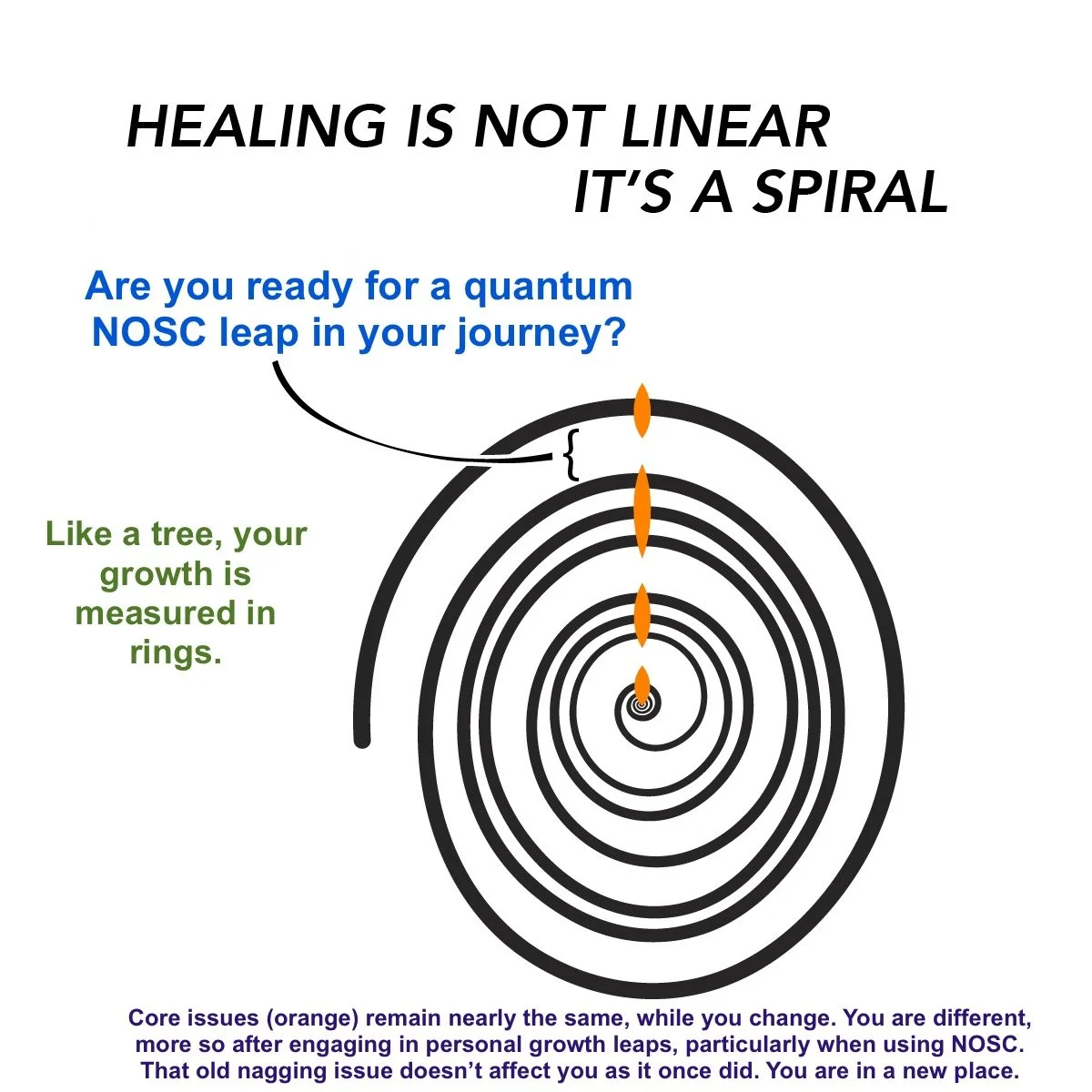
Reflections on “Do Psychedelics Create False Memories? Five Questions with Psychologist Samuli Kangaslampi”
By Lisa Gilbert, MD
Published on LinkedIn 7-1-2026
A person should never enter psychedelic‑assisted psychotherapy (PAP) or Holotropic Breathwork (HB) with the intention of obtaining legal evidence. Such an aim is categorically incompatible with these modalities. Their purpose is not forensic; it is the movement toward wholeness.
I am increasingly inclined to shift the vocabulary from repressed memory to compressed memory.* Trauma can be compressed in the body, in the mind through denial and dissociation, and within the deeper strata of the psyche or soul. PAP and HB are technologies capable of decompressing “trauma kinetics” across all three domains. The goal is not to “recover” repressed memories but to release the energetic charge of compressed trauma. That release is only one phase. Subsequent nonordinary states of consciousness (NOSC) work moves a person toward wholeness, transcendence, and a resolution far more meaningful than proving a particular trauma occurred.
There is no verified disorder called False Memory Syndrome. Academic research on memory—particularly laboratory‑based studies—is so far unable to explore memory as it emerges while in NOSC. For example, Kangaslampi describes a diary‑based method in which participants record true and false events, later testing whether they “remember” fabricated ones. This paradigm does not apply to somatically engaged trauma memory or NOSC experiences. It is an apples‑and‑oranges comparison. Reductionistic interpretations confuse the public and are frequently misused as “proof” of claims that simply do not apply to NOSC‑based healing.
Trauma itself is complex—even when external “proof” exists. In my own case, I have a direct witness to my childhood abuse. Yet that witness refuses to publicly bare witness and would lie if questioned. If my story ever entered a courtroom, they would very likely perjure themselves. Why? Familial and generational denial. Shame. Fear. The belief that truth might harm their children. These dynamics illustrate why legal frameworks often fail to capture the lived reality of trauma.
Within NOSC, questioning an experience while it unfolds is counterproductive. The task is surrender. If the body, mind, or soul holds trauma, a person may revisit the actual event—or they may experience a vivid “past life” scenario, such as fighting in a Viking battle. It does not matter. Both can serve as catalysts that loosen and extricate trauma kinetics from their compressed entrenchment. Curiously, there is less public debate about past‑life experiences than about the unlikely scenario of implanted false memories. The debate itself is largely irrelevant to the vertical work of healing.
Stopping midway through a deep healing process to confront or prosecute a perpetrator based on NOSC‑derived material is profoundly misaligned with the purpose of PAP or HB. It is a horizontal application—concerned with blame, vengeance, and justice—rather than a vertical one, which concerns groundedness, transcendence, and integration. Horizontal processes belong to courts, social media, and intellectual argumentation. They are not part of Grof’s cartography of the psyche.
Validation, however, is essential. During my own personal NOSC work, my denial was so dense that external validation served as a lifeline. I often asked facilitators whether my process appeared authentic. I assumed their experience with hundreds of sessions gave them insight into depth versus superficiality—an assumption I later learned was imperfect but understandable. Over time, as my experiences became unmistakably non‑contrived, unpredictable in trajectory, and profoundly relieving, I no longer needed external validation.
I understand the academic desire to theorize and test hypotheses about memory. But as a survivor, I cringe. Self‑validation is arduous. Moving from trauma kinetics to transcendent kinetics is vital—and fragile. Denial, both individual and communal, is toxic. Unfortunately, it is often reinforced by well‑meaning researchers whose conclusions can be overgeneralized or appropriated by false‑memory advocates seeking to bolster political arguments through misapplied data.
*Compressed memory, (not related to computer operating system’s memory) a term first coined by Lisa Gilbert, MD, refers to trauma‑related material that has been compacted, constrained, or energetically sealed within the body, mind, or deeper psyche and soul. Unlike the traditional notion of repressed memory, which implies a psychological pushing‑down of content, compressed memory emphasizes the kinetic, somatic, and energetic mechanisms through which trauma becomes densely stored and consciously inaccessible. Compressed memory is not simply forgotten; it is pressurized. It is held in a way that affects physiology, emotion, behavior, and identity—even when the narrative content of the trauma is unavailable.
For more on trauma kinetics and transcendent kinetics see Soul Can You: How Expanded Consciousness Cultivates Spiritual Awakening, Trauma Healing, and Creative Breakthroughs.
Dr. Kangaslampi’s article was published in The Microdose -Jun 2026.
[All content is original, not AI.Copilot AI was used for editing only.]

More Articles
” Beyond the Evidence-Based Menu: Healing Through Consciousness Expansion”
August 20, 2025
Best Retreats
(Like the Better Business Bureau — But for Ayahuasca Retreats)
“Beyond the Mind: How Expanded Consciousness Fuels Healing, Creativity, and Awakening”
August 26, 2025
Shaman Portal : The Resource for All Things Shamanic
Itzhak Beery– Publisher
“Mismatched Energies”
Issue: Autumnal Equinox 2025
Drop & Buds Journal - is a project of the Dreamshadow® Group, Inc.
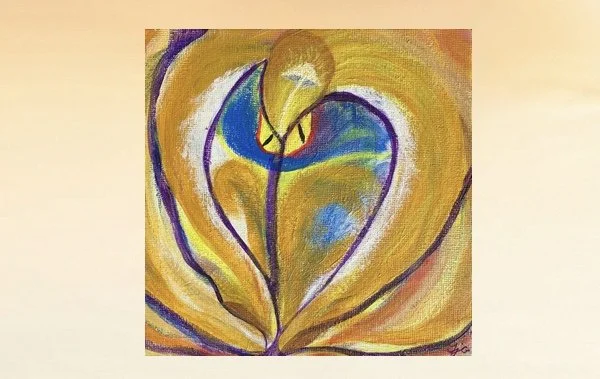
This HB mandala depicting animal spirit guides helping with mismatched inner energies: burning trauma kinetics and dripping fatigue.
4/29/26 Spirituality and Health Newsletter