
EDITORIAL REVIEWS
A deeply vulnerable and inspiring account of personal healing through “transcendent kinetics,” …a stirring testament to our capacity for recovery and renewal…Narratively rich and relevant for any stormy season of life…balanced neatly between ancient wisdom and the cutting edge of therapy - The Independent Review of Books
Lisa Gilbert’s Soul Can You is part memoir, part spiritual exploration, and part psychological roadmap. The book follows Gilbert’s journey through trauma, healing, and transformation via Holotropic Breathwork® and other nonordinary states of consciousness. Drawing from her life as both psychiatrist and seeker, she recounts vivid encounters with inner visions, long-buried memories, and spiritual entities. It’s a work that blends scientific insight with mystical experience. Beneath its explorations lies a simple truth: that healing begins when one dares to meet the soul head-on, without fear of what it may reveal.
Gilbert’s writing pulses with honesty. She doesn’t sugarcoat the pain or distance herself from it. Her words feel lived in. I could sense her vulnerability in moments of loss and awe. I admired how she used storytelling as a bridge between psychiatry and spirit. Her scenes of breathwork, those intense, body-soul journeys, made me feel like I was right there, breathing with her. At times I questioned what was literal and what was visionary, but that uncertainty felt right. The power of the book isn’t in proving what’s “real.” It’s in showing how real healing feels.
I couldn’t help but be drawn in by her sincerity. The rhythm of her prose changes like breath itself, fast, then still. I found myself moved by her courage to face shame, grief, and abuse without hiding behind her medical training. I’ve read plenty of books about trauma and consciousness, but few manage this balance of intellect and heart. Gilbert’s voice is gentle and unpretentious, even when describing experiences that defy logic.
I’d recommend Soul Can You to anyone standing at the crossroads between science and spirituality, or to those who feel stuck in their own healing. If you’ve ever wondered whether the soul can survive the chaos of a modern life, this book says yes, and shows you how it learns to breathe again. -Literacy Titan Book Review
A bold, soul-deep exploration of healing, consciousness, and inner truth.
Gilbert, a board-certified psychiatrist with decades of clinical experience, takes a psychospiritual look at the inner world of trauma, healing, and consciousness expansion in her debut book. Though trained in the rigors of Western psychiatry, she ventures into territory that traditional clinical frameworks rarely attempt to map, arguing—through lived experience rather than abstraction—that the psyche’s deepest wounds often contain their own medicine. She opens with the story of a spectral visitation in meditation, in which a long-lost neighbor child tells her, “It wasn’t your fault,” a moment that instantly signals the book’s blend of psychological inquiry and mystical encounter.
From there, she retraces years of Holotropic Breathwork sessions that operate much like case studies of consciousness, detailing visions in which shame becomes embodied, trauma speaks in symbolic language, and identity dissolves into what she calls “Divine Light.” Like a clinician documenting an unfamiliar phenomenon with precision and awe, Gilbert recounts these experiences not for sensational effect but to show how nonordinary states can reveal patterns that have shaped a lifetime. Readers watch as she interrogates buried memories, confronts childhood fragmentation, and revisits scenes of emotional rupture—always returning to the central question of what healing truly demands. When she describes the energetic residue of trauma as “trauma kinetics,” or the counterforce of awakening as “transcendent kinetics,” she does so not as rigid theory but as a framework that helps make sense of what the psyche is already expressing. Her encounters with the departed often arrive with a startling intimacy—like the moment Harold, speaking from within a ritual drum, reassures her, “They will never take my power,” collapsing the boundary between the human and the mythic.
Gilbert’s candor is one of the book’s greatest strengths. She refuses to sanitize the confusion, devastation, or awe that accompany deep inner work. Introspection and analysis blend smoothly throughout, keeping visionary experiences rooted in emotional truth. A guide’s calm assurance—“You will see me again, and I will teach you”—avoids melodrama and strengthens the book’s conversation between the seen and unseen parts of the self. Despite the depth of her subjects, her writing remains clear and inviting. Thoughtful, multilayered, and unflinchingly sincere, the book offers a lived blueprint for those wanting to understand the deeper patterns shaping their inner lives. Readers who loved When the Body Says No by Gabor Maté and Journey of Souls by Michael Newton will want to take a look. – Prairies Book Review

5*- Enlightening and Inspiring!
Soul Can You is a beautiful memoir written by Dr. Lisa Gilbert, who skillfully manages to intersect psychiatry, spirituality, and transformative practice…I felt my soul awakening as I read. I also found myself having very interesting dreams when I read before going to sleep… Dr. Gilbert’s work has inspired me to dig in deeper for not only healing but also working on expanding my own consciousness… She truly has a gift for inspiring and motivating others to follow this path of healing…The discussions of NOSC (mystical experiences, meditation, or spontaneous phenomena) put that book within a larger tradition of contemplative science, as it allows for the subjective nature of the spiritual experience to be involved while still maintaining a clinical perspective.
Overall, Soul Can You is essential reading for both seekers and healers. It offers hope for people to be able to learn how to face trauma, have a spiritual awakening, and experience transformation. This is the perfect resource for those who are drawn to Holotropic Breathwork and who would like to integrate psychology with spirituality! – Reader Views







🏆 BOOK AWARDS 🥇
Literary Titan Book Award - nonfiction gold winner -NOV 2025
2025 The BookFest - silver winner : Body, Mind & Spirit
2026 Nautilus Book Awards -silver winner in Spirituality in Other Traditions
American Writing Awards - first place winner in Spirituality -2025
Reader Views Literary Award 2025 -Non-Fiction -Body/Mind/Spirit —Gold Winner
AND
Reader Views Literary Award 2025– Regional Award Winner – Great Lakes
2025 Eric Hoffer Book Awards - category Finalist
2026 International Impact Book Awards - “outstanding literary achievement” in Spirituality
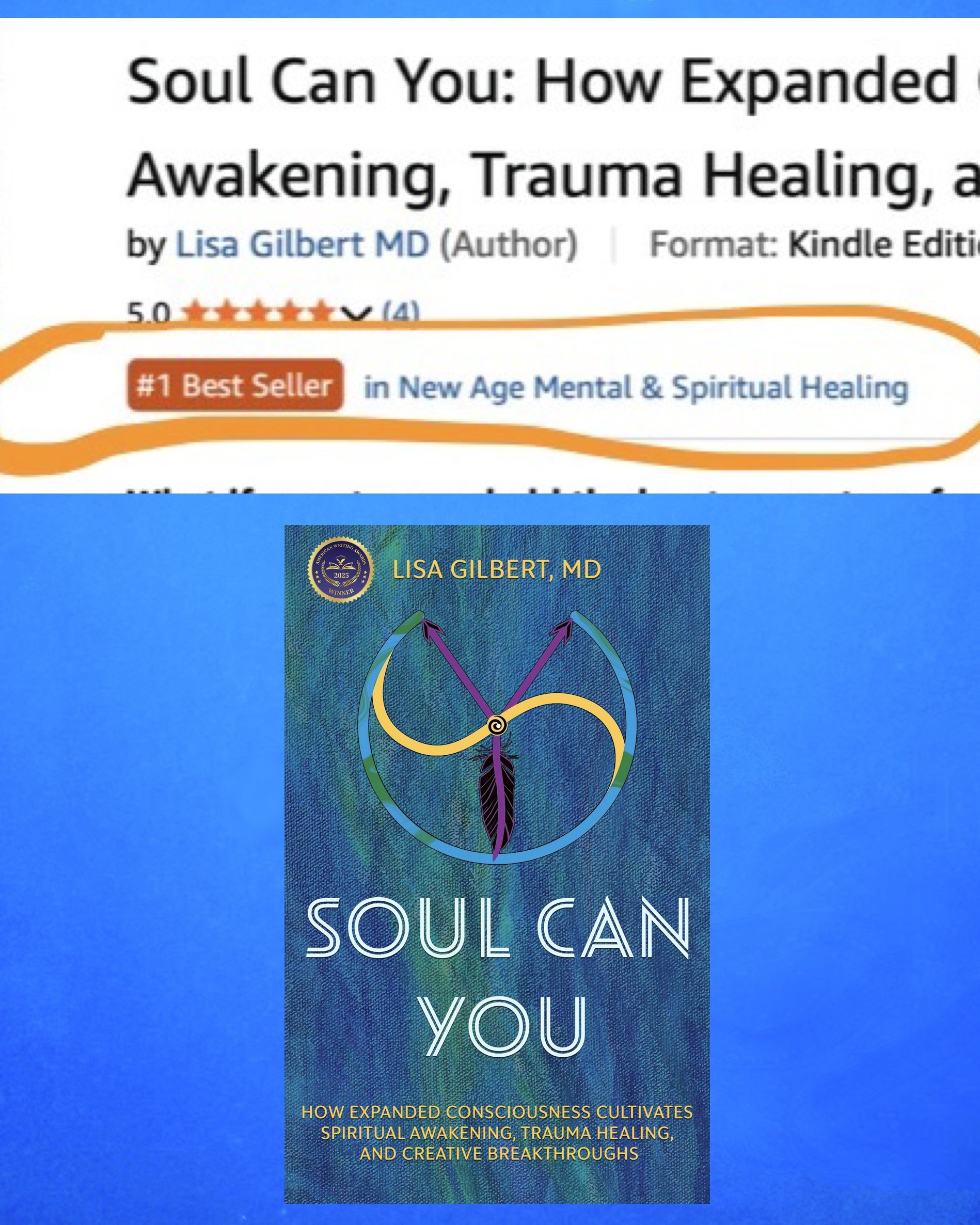
Amazon Reviews:
READERS’ REVIEWS
ROBIN ⭐️⭐️⭐️⭐️⭐️
Eye-opening and Uplifting
“Soul Can You” really resonated with me on a personal level. Lisa Gilbert shares her experiences with such honesty and warmth as she combines her background in psychiatry with spiritual practices in an open-minded and uplifting manner. I found myself reflecting on my own journey as I read it.
What struck me most was her perspective on trauma. Instead of viewing it only as something to recover from, she shows how it can become a doorway to creativity, self-discovery, and even spiritual awakening. That message stayed with me, and it made me think differently about challenges I’ve faced in my own life. By the time I finished, I felt lighter, more hopeful, and more open to growth.
This book isn’t just about healing; it’s about transformation, and it’s written in a way that makes you believe that kind of change is possible. I’d recommend it to anyone working through hardship or simply searching for deeper meaning in their life.
PIARAS ⭐️⭐️⭐️⭐️⭐️
When Trauma Becomes a Doorway.
Lisa Gilbert's ‘Soul Can You’ reads like a conversation with a wise friend who has walked through darkness and emerged with something luminous to share. This isn't clinical memoir—it's healing guide, spiritual journey, and fierce anthem for wholeness all wrapped into one breathing thing.
Gilbert writes from that raw place where her inner healer meets her wounded self, discovering what many of us suspect: our deepest hurts aren't just damage to recover from, but doorways worth walking through. She won't settle for "good enough"—she's chasing the kind of integration where body, mind, and spirit stop being separate countries.
For anyone pulled toward where medicine touches mystery, this book becomes both roadmap and traveling companion. The kind of read that quietly shifts something inside you. Absolutely worth the read.
MARY B ⭐️⭐️⭐️⭐️⭐️
A Book that Makes a Difference!
Lisa Gilbert MD is a superb storyteller. She relates deeply personal and transformative experiences while at the same time is able to convey a lot of relevant information. She also had the foresight to insert small courtesy symbols alerting readers to content with descriptions of violence, allowing readers to skip those segments if they prefer. Her authentic and richly descriptive journeys were captivating. And I found myself contemplating my own life and healing while engaged with Dr. Gilbert’s story. Truly a marvelous book that I highly recommend and count me in on being “naganited.”
Elise Wardle MA, Jungian Psychotherapist ⭐️⭐️⭐️⭐️⭐️
Cosmic Journey Through Healing
My sincere thanks to Lisa Gilbert for offering us a beautifully enlightened view of her own profoundly moving journey through trauma on every level, personal, familial, ancestral and collective. With the continued and regular practice of Holotropic Breathwork she has successfully transcended the many layers of deeply embedded and mostly unconscious trauma held in the body through a history of early abuse and toxic family dynamic. She shows us through her work how it is possible to not only heal our earliest wounds but move in, through and beyond to the greater work of healing others including ancestral layers of trauma throughout evolution thus contributing to the healing of our planet in crisis. This is a book for all of us whether or not we choose (or are called) to undertake this difficult path of healing ourselves, humanity and our planet. Whether we work with breath, medicine, meditation, magic, prayer or other, each of us has a role to play in the cosmic journey towards healing. We simply need to 'wake up' to the fact that if we continue to function without questioning who we really are and our own role in the evolution of our planet, we face catastrophic collapse of our world.
This is an important book especially for those of us embarking on diving into deep psychological and profoundly spiritual work where we cannot bypass the darkest parts of who we are and must face them, work through our personal layers of darkness, embedded shame, pain and guilt in order to become the true channels for healing ourselves and the greater whole.
Gratitude to you Lisa. A profound memoir indeed!
GOODREADS REVIEWS:
AVIRA N. ⭐️⭐️⭐️⭐️⭐️
Gilbert, a board-certified psychiatrist with decades of clinical experience, takes a psychospiritual look at the inner world of trauma, healing, and consciousness expansion in her debut book. Though trained in the rigors of Western psychiatry, she ventures into territory that traditional clinical frameworks rarely attempt to map, arguing—through lived experience rather than abstraction—that the psyche’s deepest wounds often contain their own medicine. She opens with the story of a spectral visitation in meditation, in which a long-lost neighbor child tells her, “It wasn’t your fault,” a moment that instantly signals the book’s blend of psychological inquiry and mystical encounter.
From there, she retraces years of Holotropic Breathwork sessions that operate much like case studies of consciousness, detailing visions in which shame becomes embodied, trauma speaks in symbolic language, and identity dissolves into what she calls “Divine Light.” Like a clinician documenting an unfamiliar phenomenon with precision and awe, Gilbert recounts these experiences not for sensational effect but to show how nonordinary states can reveal patterns that have shaped a lifetime. Readers watch as she interrogates buried memories, confronts childhood fragmentation, and revisits scenes of emotional rupture—always returning to the central question of what healing truly demands. When she describes the energetic residue of trauma as “trauma kinetics,” or the counterforce of awakening as “transcendent kinetics,” she does so not as rigid theory but as a framework that helps make sense of what the psyche is already expressing. Her encounters with the departed often arrive with a startling intimacy—like the moment Harold, speaking from within a ritual drum, reassures her, “They will never take my power,” collapsing the boundary between the human and the mythic.
Gilbert’s candor is one of the book’s greatest strengths. She refuses to sanitize the confusion, devastation, or awe that accompany deep inner work. Introspection and analysis blend smoothly throughout, keeping visionary experiences rooted in emotional truth. A guide’s calm assurance—“You will see me again, and I will teach you”—avoids melodrama and strengthens the book’s conversation between the seen and unseen parts of the self. Despite the depth of her subjects, her writing remains clear and inviting. Thoughtful, multilayered, and unflinchingly sincere, the book offers a lived blueprint for those wanting to understand the deeper patterns shaping their inner lives. Readers who loved When the Body Says No by Gabor Maté and Journey of Souls by Michael Newton will want to take a look.